

There is a lot being written about AI taking our jobs…If you sit at a desk, apparently, good luck. In 5 years, you’ll be replaced. I’m not convinced it’s quite that simple.
At Reg&Partners, like most businesses, we’re working out what AI means for us. Where does it fit? What should we use it for? What shouldn’t we use it for? And, perhaps most importantly, how can it make us better and more efficient rather than simply allowing us to do more, faster?
There are obvious opportunities.
Research. Prospecting. Insight. Data. Finding the right people. Getting to the information that used to take hours. Removing some of the repetitive, manual work that fills our days. That all feels like a no-brainer.
But it has made me think about what happens to the bit of our jobs that isn’t efficient. The bit that isn’t scalable. The bit that, actually, makes things happen.
I saw a video (https://www.youtube.com/watch?v=WnWtIzRFxhI&t=10s) about the feeling of opening the first can of beer on a trip with your friends. It sounds ridiculous when you write it down. But you know exactly what it means.
It’s not really about the beer. It’s the moment. The anticipation. The people you’re with. The fact that you’ve been looking forward to it. It’s a feeling. And it made me think about sponsorship.
Because I get a similar feeling when an email or a call comes through that says:
“Yes. Let’s do it.”
There is a feeling attached to that. And I don’t think AI can replicate it. Not because AI isn’t clever enough. But because sponsorship isn’t really about information. We can have all the information in the world.
The right audience. The right reach. The right price. The right assets. The right demographic. The right data. And still not get the deal.
Because people don’t make decisions purely on information. Sometimes the Chairperson chooses the club they love. Sometimes a CEO has a personal connection to a sport. Sometimes you’re having a coffee with someone and they mention, almost as an aside, that their kids love netball.
Or that they used to skate. Or that they went to the football every Saturday growing up. And suddenly the sponsorship you’re talking about means something different. That little piece of information probably wouldn’t appear in a CRM. It probably wouldn’t make a prospecting model. It certainly wouldn’t appear in the reach figures.
But it might be the thing that gets the deal done. That’s the strange thing about sponsorship. It has always been presented as a commercial discipline. And it absolutely is. But it is also deeply human.
It is relationships. Timing. Personality. Trust. Ego. History. Personal preference. Shared experiences. It’s lunch. It’s coffee. It’s a beer.
It’s the conversation that goes completely off topic for 20 minutes and somehow turns out to be the most important part of the meeting. It’s understanding what someone actually cares about, rather than simply what their job title tells you they should care about.
And then there’s the other side of being human. People disagree. People fall out. People change their minds. Things don’t get delivered. Someone says something they shouldn’t. Someone takes something personally. An asset doesn’t go live. A campaign doesn’t perform.
The person who loved the deal leaves the business. The spreadsheet doesn’t really account for any of that. And maybe that’s why I’m increasingly interested in AI not as a replacement for people, but as a way of giving people more time to be people.
We had an interesting conversation recently about 20:60:20. The first 20% is human. The brief. The context. The insight. The nuance. The questions. The prompt. Knowing what you’re actually trying to solve.
Then AI takes on the middle 60%. It researches. It processes. It compares. It writes. It finds patterns. It does the heavy lifting.
Then comes the final 20%. Back to humans. Checking it. Challenging it. Interpreting it. Knowing what’s missing. Knowing when the answer doesn’t feel right. And, importantly, making it human.
Because the skill isn’t necessarily in producing the answer anymore. The skill might increasingly be in knowing what question to ask, what answer to trust and what to do with it.
A colleague says something to me regularly:
“We used to write contracts, print them and send them by fax. It didn’t change the fact that we did deals. It just made the meeting more important.”
I keep coming back to that.
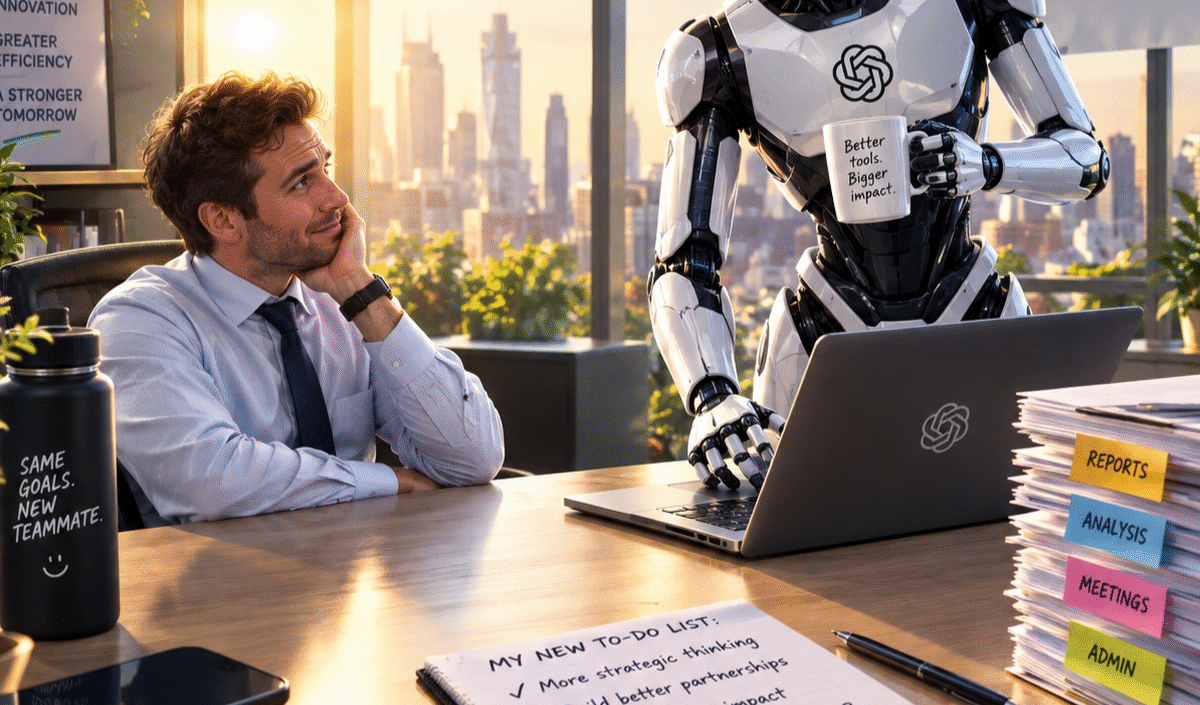
Technology has always removed parts of the process. We didn’t stop doing deals because fax machines arrived. We didn’t stop meeting because email arrived. We didn’t stop building relationships because CRM systems arrived. So perhaps AI does the same thing. Perhaps it removes another layer of the process. Perhaps it gives us another 20% of our day back.
Perhaps the unintended consequence is that the things AI can’t do become more valuable.
The conversation. The relationship. The instinct. The shared experience. The lunch. The coffee. The beer.
The moment when someone says: “Yes. Let’s do it.”
And maybe, if that’s true, the question isn’t whether AI will make us less human. Maybe it’s whether it gives us more time to actually be human. Will AI make the in-person meeting more important? I’m genuinely not sure.
But I think it’s a question worth asking.